Mobility and Fleet Barometer 2026
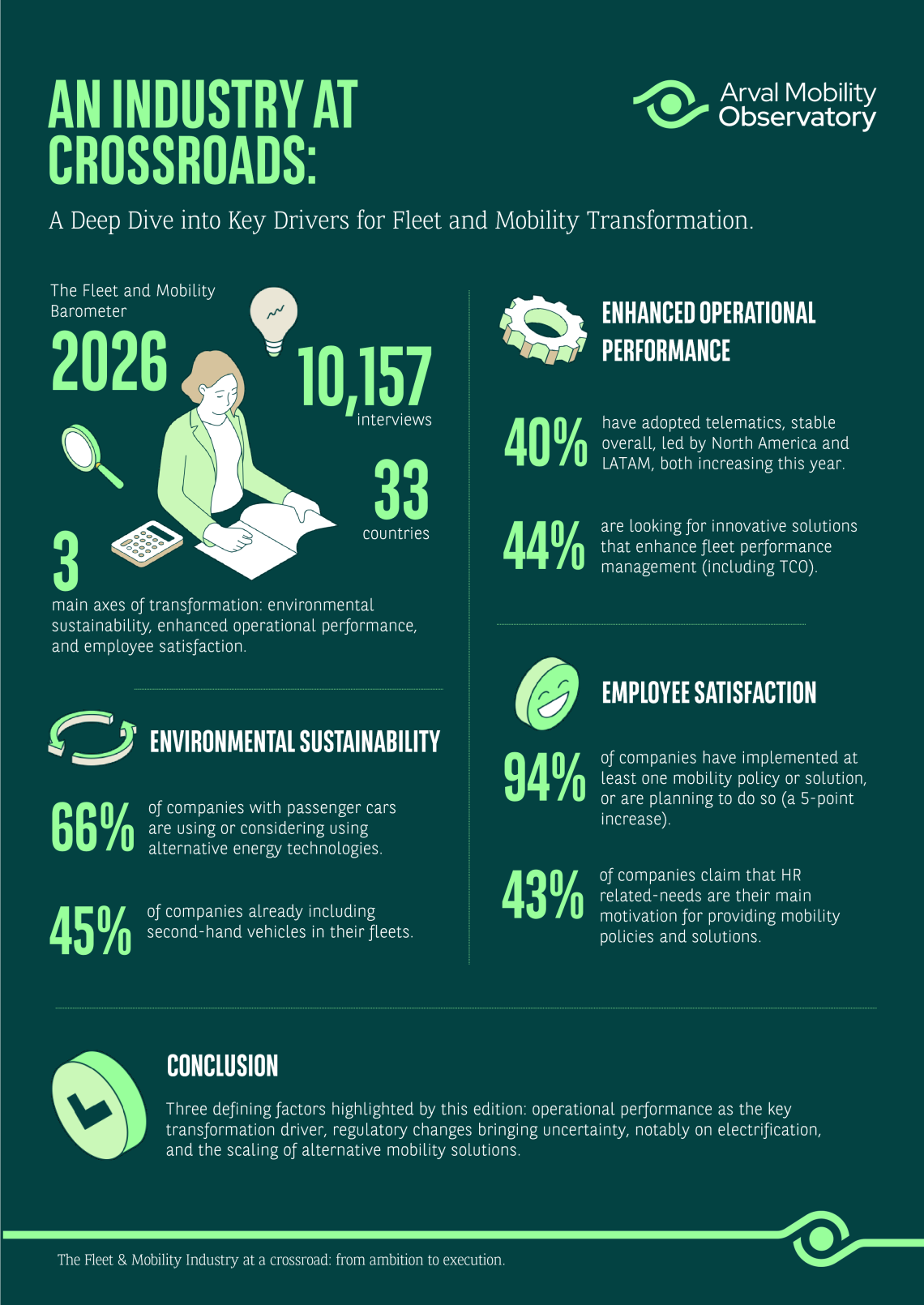
The Arval Mobility Observatory is pleased to announce the release of the Global Fleet and Mobility Barometer 2026. This edition marks a pivotal transition for global fleets. While electrification, sustainability, and operational efficiency remain core priorities, this year’s results reveal a significant evolution: companies are shifting from expansion to optimisation. With insights from 10,157 decision-makers across 33 countries, including an expanded Asia-Pacific scope, this truly global edition offers the most contrasted, operationally focused landscape to date.
Navigating a complex landscape
As fleet managers look ahead to the next three years, they will need to navigate a landscape marked by significant challenges and opportunities. The Barometer identifies three main areas of fleet and mobility transformation: environmental sustainability, enhanced operational performance, and employee satisfaction.
Here are the main takeaways
- Environmental sustainability: electrification remains a top priority, with 57% of companies in Europe already adopting or planning to adopt electrified vehicle technologies. This trend is reflected globally, where 66% of companies with passenger cars are already using or considering the use of these technologies.
- Enhanced operational performance: fleet managers are focusing on optimising their operations, with 44% of companies demanding data-driven performance tools to improve their fleet management. The use of telematics is also on the rise, with 33% of companies having adopted or planning to adopt telematics in the next three years.
- Employee satisfaction: companies are repositioning employees at the center of mobility and fleet transformation, with 94% of companies having implemented or planning to implement at least one mobility policy or solution. HR-related needs, such as talent acquisition and employee retention, are driving the development of these policies and solutions, with 43% of companies citing these as the main reasons.
Global Mobility and Fleet Barometer 2026